To learn and not to
do is really not to learn. To know and not to
do is really not to know.
- Stephen R. Covey
Inside Out
He lays out the difference between the personality ethic and the character ethic. Personality ethic focuses on outcome, character on the way something is produced. Personality ethic learns how to behave well in order to get the desired result, the character ethic concerns itself with inner change.
Covey describes a time his son wasn't meeting their expectations and he describes the realisation that their disappointment was born out of a concern for how their son made
them look:
I realised that Sandra and I had been getting social mileage out of our children's good behaviour...
How often do we/I do that? Their solution:
We stopped trying to kindly, positively manipulate him into an acceptable social mold. Because we saw him as fundamentally adequate and able to cope with life, we stopped protecting him against the ridicule of others.
You always reapy what you sow; there is no shortcut.
It is character that communicates most eloquently. As Emerson once put it:
'What you are shouts so loudly in my ears I cannot hear what you say.'
What's needed is a paradigm shift. A paradigm, Covey says, is a map:
Each of us has many, many maps in our head, which can be divided into two main categories: maps of the way things are, or realities, and maps of the way things should be, or values. We interpret everything we experience through these mental maps.
He uses the image of the woman that can be perceived as young and beautiful or old and ugly as an example of how different paradigms affect how we see the images.
Our paradigms, correct of incorrect, are the sources of our attitudes and behaviours, and ultimately our relationships with others.
He then says:
It becomes obvious that if we want to make relatively minor changes in our lives, we can perhaps appropriately focus on our attitudes and behaviours. But if we want to make significant, quantum change, we need to work on our basic paradigms.
How to grow? Submit to the process.
In all of life, there are sequential stages of growth and development. A child learns to turn over, to sit up, to crawl, and then to walk and run. Each step is important and each one takes time. No step can be skipped. This is true in all phases of life, in all areas of development, whether it be learning to play the piano or communicate effectively with a working associate. It is true with individuals, with marriages, with families and with organisations.
On helping children to 'play nicely' and share their toys he comments on the felt control and power of the child:
I've learned that once children gain a sense of real possession, they share very naturally, freely, and spontaneously.
The way we see the problem is the problem
How to get greatness:
If you want the secondary greatness of recognised talent, focus first on primary greatness of character.
Go for inside-out:
In all of my experience, I have never seen lasting solutions to problems, lasting happiness and success, that came from the outside in.
The 7 Habits - An overview
We are what we repeatedly do. Excellence, then, is not an act, but a habit. - Aristotle
Habits are like a cable. We weave a strand of it every day and soon it cannot be broken.
The power of habits:
Those of us who watched the lunar voyage of Apollo 11 were transfixed as we saw the first men walk on the moon and return to earth. Superlatives such as 'fantastic' and 'incredible' were inadequate to describe those eventful days. But to get there, those astronauts literally had to break out of the tremendous gravity pull of the earth. More energy was spent in the first few minutes of lift-off, in the first few miles of travel, than was used over the next several days to travel half a million miles.
Habits, too, have tremendous gravity pull-more than most people realise or would admit. Breaking deeply imbedded habitual tendencies such as procrastination, impatience, criticalness, or selfishness that violate basic principle of human effectiveness involves more than a little willpower and a few minor changes in our lives. 'Lift off' takes a tremendous effort, but once we break out of the gravity pull, our freedom takes on a whole new dimension.
...It is a powerful force, and if we use it effectively, we can use the gravity pull of habit to create the cohesiveness and order necessary to establish effectiveness in our lives.
Great ven diagram of knowledge, desire and skills. Where all three overlap is when we put habits into action.
Maturing.
On the maturity continuum, dependence is the paradigm of you-you take care of me; you come through for me; you didn't come through; I blame you for the results.
Independence is the paradigm of I-I can do it; I am responsible; I am self-reliant; I can choose.
Interdependence is the paradigm of we-we can do it; we can cooperate; we can combine our talents and abilities and create something greater together.
Maturity from dependence to independence is good but not the end goal:
True independence of character empowers us to act rather than be acted upon. It frees us from our dependence on circumstances and other people and is a worthy, liberating goal. But it is not the ultimate goal in effective living.
Independent thinking alone is not suited to interdependent reality.
Effectiveness defined:
He tells the story of the golden egg producing goose and introduces the concept of P/PC Balance. A farmer discovers to his amazement that one of his geese produces golden eggs. He then sets about ensuring the goose produces as many of these eggs as possible but he forgets to feed the goose and it dies. There is a production and production capability balance that needs to be maintained to ensure effectiveness over the long term.
P stands for production and PC for Production Capability.
Parenting:
When children are little, they are very dependent, very vulnerable. It becomes so easy to neglect the PC work - the training, the communicating, the relating, the listening. It's easy to take advantage, to manipulate, to get what you want the way you it - right now! You're bigger, you're smarter, and you're right! So why not just tell them what to do? If necessary, yell at them, intimidate them, insist on your way.
Or you can indulge them. You can go for the golden egg of popularity, of pleasing them, giving them their way all the time. Then they grow up without any internal sense of standards or expectations, without a personal commitment to being disciplined or responsible.
Business:
The PC principle is to always treat your employees exactly as you want them to treat your best customers.
PC work is treating employees as volunteers just as you treat customers as volunteers, because that's what they are.
On changing others:
Marilyn Ferguson observed, 'No one can persuade another to change. Each of us guards a gate of change that can only be opened from the inside. We cannot open the gate of another, either by argument or by emotional appeal.'
Habit 1: Be Proactive
The social mirror
If the only vision we have of ourselves comes from the social mirror - from the current social paradigm and from the opinions, perceptions and paradigms of the people around us - our view of ourselves is like the reflection in the crazy mirror room at the carnival.
There are actually three social maps - three theories of determinism widely accepted, independently or in combination, to explain the nature of man:
- Genetic determinism: We are what our genes tell us we are
- Psychic determinism: We are what our parents created us to be
- Environmental determinism: We are what the environment forces us to be
Story of Victor Frankyl used to debunk this. We are more than mere determinists, we are human, able to choose for ourself.
The deterministic paradigm comes primarily from the study of animals - rats, monkeys, pigeons, dogs - and neurotic and psychotic people. While this may meet certain criteria of some researchers because it seems measurable and predictable, the history of mankind and our own self-awareness tell us that this map doesn't describe the territory at all!
'Proactivity' Defined:
While the word proactivity is now fairly common in management literature, it is a word you won't find in most dictionaries. It means more than merely taking initiative. It means that as human beings, we are responsible for our own lives. Our behaviour is a function of our decisions, not our conditions.
Reactive people are often affected by their physical environment. If the weather is good, they feel good. If it isn't it affects their attitude and their performance.
Proactive people can carry their own weather with them. Whether it rains of shines makes no difference to them. They
are value driven; and if their value is to produce good quality work, it isn't a function of whether the weather is conducive to it or not.
The ability to subordinate an impulse to a value is the essence of the proactive person. Reactive people are driven by feelings, by circumstances, by conditions, by their environment. Proactive people are driven by value - carefully thought about, selected and internalised values.
As
Eleanor Roosevelt observed, 'No one can hurt you without your consent.'
In the words of
Gandhi, 'They cannot take away our self-respect if we do not give it to them.'
It is our willing permission, our consent to what happens to us, that hurts us far more than what happens to us in the first place.
It's not what happens to us, but our response to what happens to us that hurst us. Of course, things can hurt us physically or economically and can cause sorrow. But our character, our basic identity, does not have to be hurt at all.
Victor Frankyl suggest that there are three central values in life - the
experiential, or that which happens to us; the
creative, or that which we bring into existence; and the
attitudinal, or our response in difficult circumstances such as terminal illness.
Taking the Initiative:
Whenever someone in our family, even on of the younger children, takes an irresponsible position and waits for someone else to make things or provide a solution, we tell them, 'Use your R and I!' (resourcefulness and initiative). In fact, often before we can say it, they answer their own complaints, 'I know - use my R and I!'
Listening to our language
Our language is a very real indicator of the degree to which we see ourselves as proactive people.
He then lists a set of phrases: reactive language and proactive language.
In the great literature of all progressive societies, love is a verb. Reactive people make it a feeling. They're driven by feelings. Hollywood has generally scripted us to believe that we are not responsible, that we are a product of our feelings.
Circle of concern/Circle of Influence
One way to determine which circle our concern is in is to distinguish between the
haves and the
bes. The Circle of Concern is filled with the
haves: I'll be happy when I have or if I had or if only I had etc.
Joseph in the OT instead focused on 'being' rather than 'having'. When a slave in Egypt he concentrated on how to be. He was a conscientious, hard working, worshipping slave and as a resutl what he 'had' increased as well.
We are free to choose our response in any situation, but in doing so, we choose the attendant response. "When we pick up one end of the stick, we pick up the other."
Knowing that we are responsible - response'able' - is fundamental to effectiveness and to every other habit of effectiveness we will discuss.
Habit 2: Begin with the end in mind
Start with a clear understanding of your destination.
It's incredibly easy to get caught up in an activity trap, in the busyness of life, to work harder and harder at climbing the ladder of success only to discover it's leaning against the wrong wall. It is possible to be busy - very busy - without being very effective.
All things are created twice.
The carpenter's rule is 'measure twice, cut once.'
To the extent to which we understand the principle of two creations and accept the responsibility for both, we act within and enlarge the borders of our Circle of Influence.
Leadership and management - the two creations.
Leadership is not management. Management is the second creation:
Management is doing things right; leadership is doing the right things
I'm convinced as well that too often
parents are also trapped in the management paradigm, thinking of control, efficiency, and rules instead of direction, purpose and family feeling.
Personal mission statements.
The most effective way I know to begin with the end in mind is to develop a personal mission statement or philosophy or creed. It focuses on what you want to be (character) and to do (contributions and achievements) and on the values or principles upon which being and doing are based.
It's about getting the right 'centre' out of which flow our wisdom, security, guidance and power. Chapter then deals with false centres (or idols as the Bible calls them) and shows how the wrong centre can create disastrous results.
Malcolm Muggeridge writes in 'A Twentieth-Century Testimony' reflects on what makes life successful and effective:
When I look back on my life nowadays, which I sometimes do, what strikes me most forcibly about it is that what seemed at the time most significant and seductive, seems now most futile and absurd. For instance, success in all of its various guises; being known and being praised; ostensible pleasures, like acquiring money or seducing women, or traveling, going to and fro in the world and up and down in it like Satan, explaining and experiencing whatever Vanity Fair has to offer.
In retrospect, all these exercises in self-gratification seem pure fantasy, what Pascal called, 'licking the earth.'
Instead of false centres Covey suggests we need instead to be 'principle' centred.
He uses the example of a man who plans to take his wife to the theatre only to receive a call from the office. A principle centred man processes that phone call differently than a success/money/career centred one.
Using your whole brain
Left sided vs right sided brain thinking. The left side is logical and rational, the right, creative and imaginative. We need to move out of our 'comfort zone' hemisphere and process things In the words of Abraham Maslow, 'He that is good with a hammer tends to think everything is a nail.'
Two ways to tap the right brain: 1. Expand perspective
Sometimes we are knocked out of our left brain environment and thought patterns and into the right brain by an unplanned experience. The death of a loved one, a severe illness, a financial setback, or extreme adversity can cause us to stand back, look at our lives, and ask ourselves some hard questions: 'what's really important? Why am I doing what I'm doing?'
But if you're proactive, you don't have to wait for circumstances or other people to create perspective-expanding experiences. You can consciously create your own.
Big IDEA:
Without involvement, there is no commitment. Mark it down, asterisk it, circle it. No involvement, no commitment
Habit 3: First Things First
Principles of personal management. Habit 1 says you're the creator, you're in charge. Habit 2 is the mental creation. It's based on
imagination, the ability envision, to see potential, to create with our minds. Habit 3 then is the second creation, the physical creation.
My own maxim of personal effectiveness is this: Manage from the left; lead from the right.
The power of independent will
The degree to which we have developed our independent will in our everyday lives is measured by our personal integrity. Integrity is, fundamentally, the value we place on ourselves. It is our ability to make and keep commitments to ourselves, to 'walk our talk.' It's honour with self, a fundamental part of the Character Ethic, the essence of proactive growth.
Effective management is putting first things first. While leadership decides what 'first things' are, it is management that puts them first, day-by-day, moment by moment
The best thinking of time management can be captured in a single phrase:
Organise and execute around priorities.
'Time management' is really a misnomer - the challenge is not to manage time, but to manage ourselves.
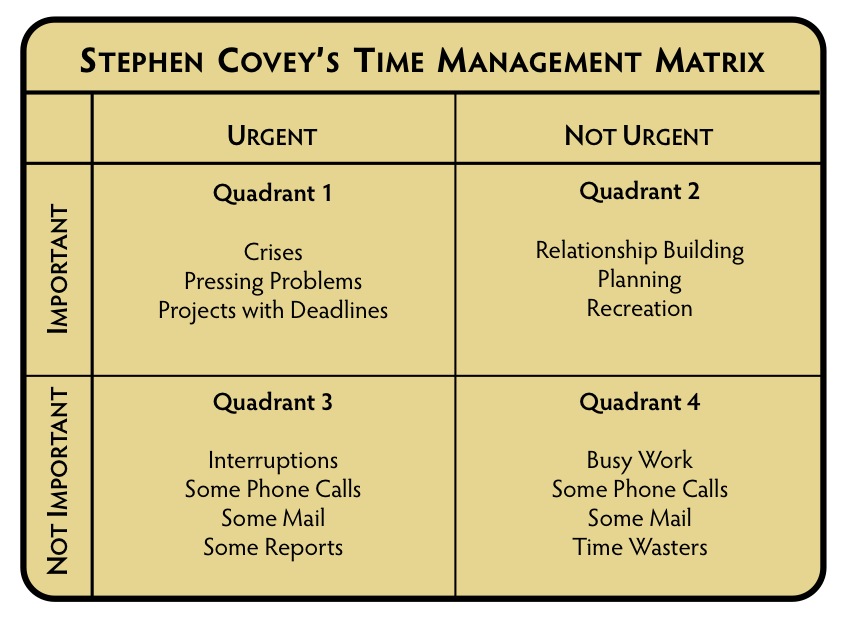
Quadrant II
Learn to lead and live out of the right quadrant.
If we spend too much time to in Quadrant 1 the results are: stress, burnout, crisis management, always putting out fires.
If we live in Quadrant 3: short-term focus, crisis management, reputation-chameleon character, see goals and plans as worthless, feel victimised, out of control, shallow or broken relationships.
The results however of living in Quadrant II are: vision, perspective, balance, discipline, control, few crises.
The only place to get time for Quadrant II in the beginning is from QIII & IV. You can't ignore the urgent and important activities of QI, although it will shrink in size as you spend more time with prevention and preparation in QII.
To say 'yes' to the things that go into QII means learning to say 'no' to other activities, sometimes apparently urgent things.
The enemy of the 'best' is often the 'good'.
The Quadrant II tool for management is to manage our lives effectively from a centre of sound principles. Quadrant II organisers will need to meet six important criteria:
COHERENCE.
BALANCE.
QII FOCUS.
A 'PEOPLE' DIMENSION.
FLEXIBILITY.
PORTABILITY.
Organising on a weekly basis provides much greater balance and context than daily planning.
The key is not to prioritise what's on your schedule but to schedule your priorities.
Principle:
Think effectiveness with people and efficiency with things.
Remember:
Frustration is a function of our expectations and our expectations are often a reflection of the social mirror rather than our own values and priorities.
Go for stewardship delegation:
Trust is the highest form of human motivation. It brings out the very best in people. But it takes time and patience.
The principles involved in stewardship delegation are correct and applicable to any kind of person or situation. With immature people, you specify desired results and more guidelines, identify more resources, conduct more frequent accountability interviews, and apply more immediate consequence.