Thursday, 7 January 2016

David Devenish : Culture & Mission

World Mission:

'clan' is the word 'ethnos' meaning people group or ethnicity.

'stan' in the name of a nation means 'land'. Paki-stan, Kazakhstan, Tajikistan etc. 'Paki' means 'holy' so 'Pakistan' means 'holy land'

Culture:

60% of the world live 6 to a room. Personal space is privilege of affluence.

Does relationship precede function or does function precede relationship? Every culture values function and relationship, it's just a question of which is the priority.

Jimmy Carter understood this when he was President of America. He managed to get Yassa Arrafat and the president of Israel together at Camp David. After 3 days the press wanted to know if progress was being made. 'Yes,' he replied 'we are making very good progress, we each know the name of one another's grandchildren.'

We smile at people to make them happy even when we don't agree with them. In other cultures they may lie to you in order to make you happy.

In western cultures we honour people by inviting them to our home. In eastern cultures you honour them by going to their home.

Jesus parable of the persistent friend at midnight:
In the west that parable is largely taught to illustrate the importance of persevering in prayer.
In the east - it is because of the honour of the village he responds to his friend's request. Which one glorifies God most? The persistent knocking or the man who 'for the honour of his name' will answer. God, for the honour of his name and glory, will give us what we want and need.
We are not born with a culture but we are born into a culture and we start learning it from the moment of our birth.

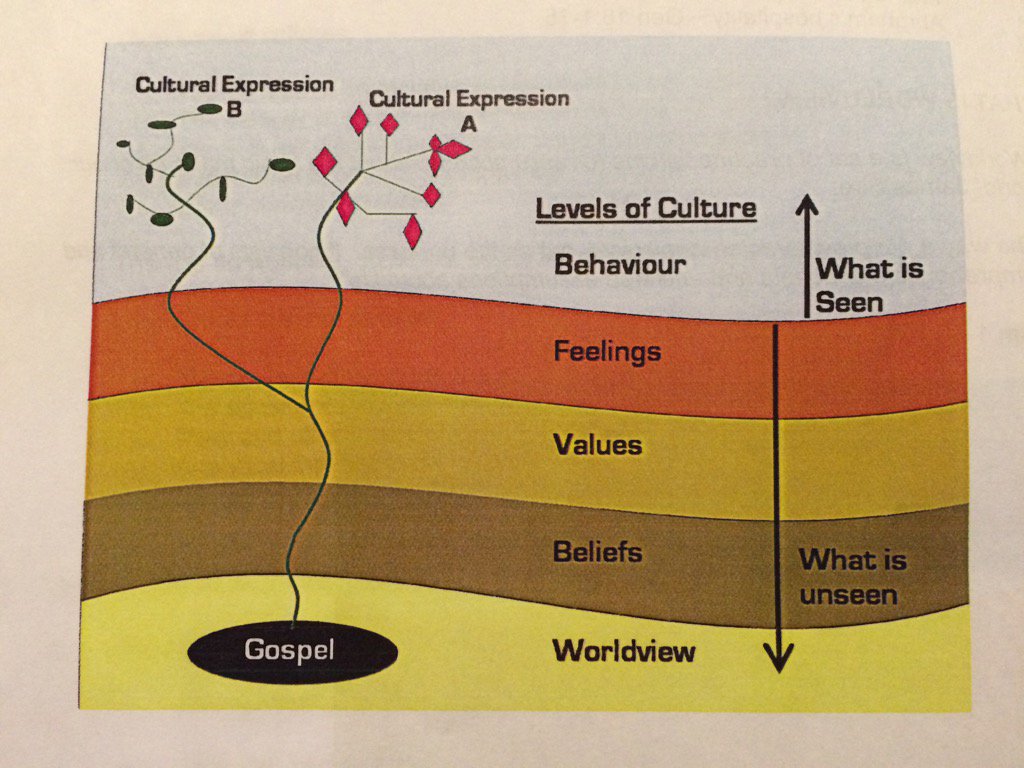
Worldviews:

Levels of culture:


Seen:
Behaviour -

Unseen:
Feelings -
Values - what a society thinks is important.
Beliefs - what does a culture believe.
Worldview - basic attitude to life.

Story:

Preaching in India when a group of people arrive toward the end asking the man of God to bless their water bottle so that every day they could pour out a drop of water to give them good luck.
If the preacher would have questioned their beliefs these people would have said their beliefs were Christian, and yet their worldview was still superstition paganism.

Worldview is essentially a story. You change a worldview by changing someone's story of how they see themselves.

Wednesday, 6 January 2016

Buckets : Prayer

Mike Betts:

God is more interested in us giving him our attention than he is in us giving him our time.

Being attentive to God constantly is better than giving him time occasionally.

C.S. Lewis: “We all go through periods of dryness in our prayers, don’t we? I doubt whether they are necessarily a bad symptom. I sometimes suspect that what we feel to be our best prayers are really our worst; that what we are enjoying is the satisfaction of apparent success, as in executing a dance or reciting a poem. Do our prayers sometimes go wrong because we insist on trying to talk to God when He wants to talk with us?”

Wendy Mann - Our Identity Battle

Stories

Manjeet. In the dentist waiting room felt God speak to her and say 'ask him about his honeymoon.' she didn't know that he was engaged. She entered the room and said 'what's going on about your honeymoon?' He was taken aback as the night before he and his fiance were talking about their honeymoon and planning it.

Then while the dentist was working on her teeth felt the HS say 'ask him about his new shoes.' so she did. 'how weird' the dentist said, I bought new shoes on Saturday! What's going on? How do you know these things about me? At which point she took the opportunity to tell the man about Jesus.

----

Navigating Mystery

The reality is that when mystery comes/disappointment comes we often stop praying for breakthrough because it is too painful for us to go again and keep believing. The trouble is that when we stop praying for and believing for breakthrough, we don't see it.

Process the pain well, deal with the pain and get to a place of faith and go again.

How do we deal with disappointment. Disappointment comes when we don't see the things that we expect to see when we believe for and pray for God to move and he doesn't in the way we expect.

Most people just squash disappointment and don't process it well.

If you don't know how to process pain well it doesn't go anywhere. Time isn't a healer, Jesus is the healer.

How to process pain well: (Psalm 13)

  1. Express your pain out loud to God: unfiltered/uncensored! 
  2. Spend time in the Psalms until you hear your own voice speaking.
  3. Speak out loud the truth about who God is: his unchanging character and nature.
  4. Lay down your right to understand.

The Kingdom

If you want to see miracles, work among the poor, because God loves to bring justice!

Joy: spectrum of responding to God

Reflective and contemplative at one end - manifestations, wobbling, shouting, jumping, dancing.

REFLECTIVE: These people look down on the others and accuse them of being 'of the flesh' attention seeking, shallow, emotional etc.

HYPER: Look at the reflective types and think 'bless' and accuse them of being 'bound up emotionally' and 'unspiritual' etc.

Most of us however are sat in the middle and look at both ends of the spectrum and judge them both.

Areas of influence we want to see Christians released into to bring the kingdom in:

  • ARTS & Entertainment
  • BUSINESS
  • CHURCH
  • Distribution of MEDIA
  • EDUCATION
  • FAMILY
  • GOVERNMENT
  • HEALTHCARE

Our Identity Battle:

The battle is on. We need not only to get information but also revelation. Understanding this

God knows who we are, the angels know who are, the demons know who we are; we're the only ones who don't know who we are.

For the disciples there was something about being with Jesus that made them feel significant. When Jesus rebuked the disciples for arguing over greatness Jesus didn't rebuke them for wanting to be great. He said 'if you want to be great, become like a little child.'

The only place that John is described as 'the disciple whom Jesus loved' is in his own gospel!

Jesus' baptism:

1) Our identity: we are also beloved.
  • We are God's beloved sons and daughters. Beloved: cherished, dearly loved, the object of one's affections. 
  • We are Brand new creations in Christ. We have a new nature. We have a default DNA now to honour God.
  • Heirs of God coheirs with Christ. 
  • Holy in God's sight without blemish and free from accusation. 
  • Seated with Christ in heavenly places. We have access to the resources of heaven. 
  • Ambassadors. Christ's representatives. When we walk into a room in some way it's as though Jesus walks into the room.
Humility is having an accurate description of who you are but it's recognising that it's all because of his grace. 

When we understand this truth it gets rid of comparison. It's ok to be inspired by another person but you should never want to be another person.

Our identity isn't based on anything we do, it's all to do with Jesus. 

2) God's pleasure in us: At Jesus' baptism I/we would have had an issue. The Father was pleased with him and yet... he hadn't done anything. 

Because our identity in christ has nothing to do with us, there's nothing we can do to mess it up.

Story of bringing a prophetic song and it not going how she wanted. Sitting down feeling ashamed and sensing God come and sit next to her, lean in and say 'well I liked it.' She had been thinking about things in terms of her, and the church and God when in actual fact it was to do with her and God and the church afterwards.

When your identity is not in your performance it actually becomes fun to take risks and get it wrong.
Our measure of success is - did I get it right? God's measure of success is - did you give it a go?


Monday, 4 January 2016

Mike Betts - Walking With God

The simplicity of the spiritual disciplines.

Bible study:

However you do it: Consciously reconnect with God on a daily basis. Find what works for you and do it in a disciplined and intentional way. Do what you need to do to reconnect with God.

Divert daily
Withdraw weekly
Abandon Annually

Prayer:

God is more interested in us giving him our attention than he is in us giving him our time.

Being attentive to God constantly is better than giving him time occasionally.

Giving:

There's a lot of discussion about whether tithing is biblical or not but... Mike has found that throughout his married life the discipline of tithing has done him good. Over the long haul God has given us more than we could ever need and it has killed the idol of materialistic accumulation.

Proportional giving is: set aside at the end of each month...

Giving is a bit like prayer. Sometimes you've got faith and energy to prayer, other times you have to do it 'in cold blood'.

Kill things that threaten your dependancy on God.

Personal Contentment:

Book: the rare jewel of Christian contentment.

The three main ares were your contentment will be challenged: obscurity, suffering, success.

It means being happy in your own skin. Jesus introduce himself to Paul as 'Jesus of Nazareth'. Happy to be identified by his human identity, to be known by his human identity.

Define yourself by who you are and not by what you do:

Henri Nouwen: House of the Lord vs house of fear. That's a choice. Daily choose to live in the house of trust and not the house of fear.

Develop a relationship with the Holy Spirit:

The HS will increase our capacities through internal growth by his working within us.

All of us at some point in our life will have rope like circumstances around a tree trunk in our life. Something that we cannot get rid of. In God's purposes the rope of circumstances may stay around the tree trunk of life. The only way you can get a rope of the tree is for the tree to grow and snap the rope.

God will through the Spirit allow us to go through situations where we have to grow internally for us to become the people God wants us to become.

To change the landscape of our lives and characters God sometimes uses big moments - earthquakes, explosions etc. But the most common way he changes the major landscapes of our life is by the regular and pervasive power of the river of God - the Holy Spirit.

Keep listening to the Holy Spirit. When God is speaking to you:
He speaks to the fella in the cellar
not the fanatic in the attic
Relentless obedience:

If you're determined to be relentless obedient it will mean: wonderful promises about fruitfulness. In Genesis God speaks to Noah and says 'you have been spared that you might be fruitful.'

When God asks you to do something you will be unconsciously incompetent. As you start doing it you become consciously incompetent. You then move toward conscious competence and finally unconsciously competent. What God will then do is promote us to unconscious incompetence again. He keeps moving you out to the edge for fresh stories and challenge. The moment we stop risking things is when we become disobedient.

It will also mean that you encounter opposition. Walking with God means that in the end your priority is that ultimately you're concerned more with pleasing him that with pleasing other people.

Key: Obedience in the midst of great mystery.


Mike Betts - Philosophy of Ministry

Philippians 2: The servant Christ and how it informs our practise

Choices we make in how we serve God

1) Invitation or challenge?

We are wired to prefer one or the other of those choices. Some love invitation style discipleship: 'would you like to do this?' sort of questions. Some instead prefer straight talking 'you should do this.'

When it comes to serving God we take our preferences into an issue. Eg. when handling controversial topics some people take the approach of speaking out and challenging. Other churches take the stance of winsomeness and befriending over publicly challenging something.

It's not so much learning which approach/attitude is right or wrong but which is best in whats setting and to what audience?

Paul: 'it is not for me to judge those outside of the church...'
Jesus: spoke out about the behaviour of the Pharisees but not obviously about sinners.

2) Discipline or organic?

Do we thrive best by living a very disciplined life or do we thrive best when we are much more 'organic' or spontaneously spirit-led. Truth be told is that you need both.

Discipline is not the same as legalism. Discipline brings freedom. Eg. skilful guitarists. The same is true in the Christian life, eg to prophecy better and more freely requires disciplined soaking in scripture. Soaking in the Spirit then doesn't mean emptying your mind and waiting for the Spirit to drop things in. It means marinating in the truth and allowing the Spirit to bring things to the surface. To make a steak tasty you marinate it in flavoursome juices not just water.

3) Prophetic or planning?

Should we respond to what God initiates or should we proactively engage the gifting he's given us? Are you a responder or an initiator? There's choices there to make! After many years of ministry Mike Betts' conclusion is that the role of prophecy is not taken heed of as much as it should do. Scripture says that God will not do something without first telling the prophets. Whenever God wants to do something in your life he will always give indication of what he wants to do: 'the Lord is my shepherd, he leads me...'

God's problem is guidance, ours is obedience. Whenever people say 'I don't know what to do...' Mike's response is 'it's not your problem, it's his. Ask him and leave it with him. What he can't do for you is obey.

4) Legacy or achievement?

There will be a time when your earthly capacity to do anything will be over. Do you want to spend your time achieving things for yourself or do you want to make choices that help others achieve but that ensures that you leave a legacy yourself? You will in all likelihood not get the credit you deserve. Others will get it since you will have spent time investing in others for them to achieve.

You can either get other people to use their energy to serve your vision, but when you are not around your vision dies. The temptation in the world and the Christian world is for celebrity. Everything about Jesus was obscure (his birth place, his appearance, his posture).

You have to make those decisions everyday. Are you going to go for legacy or achievement?

5) Character or gifting?

Do you want to surround yourself with highly gifted people who are very capable or are you going to look for people of good character and who are loyal, faithful and true above all else?

Choosing character may take you longer to get there but it's more certain that you'll get there. You can put people on a course to learn skills but you can't put people on a course to learn character. That happens day by day in life.

6) Friendship or function?

Mike: 'I will only surround myself with people to work with who will energise me?'

Be with people who are different from you but who you enjoy being with. 30 years ago when we (NF) started planting churches we found people we enjoyed being with and then found ourselves on mission together. Now it is more a case of being on mission first and then trying to friendship along the way.

Don't sacrifice the pursuit of working in teams galvanised by friendship. Not cliques but friendships.

7) Principle or pragmatic?

This is a challenge in our day especially in the church. Is Acts descriptive or prescriptive? Is this a principle or a description? If it's a principle we have to build by it even if it's difficult.

We have to make choices about how we will build.

Comment: In the west we may not be facing persecution in the way other places are. Our persecution is more that of derision. It's a persecution upon the intelligence rather than upon the body. We have to make choices then, do we hold things out of principle and bear the societal shame or not?

8) Reliance or resource?

Do not live out of your own resource.

What God wants from us and what God has repeatedly said to Mike throughout his Christian life is that we are to be totally reliant upon him. Whether in our personal life, finances, health, vocation... whatever it is we are to be totally reliant upon him.

Unless what we live for is bigger than what we can achieve it's not of God because you can achieve that on your own!

Instead we ought to think: Come on God! Let's see what you can do with a wretch like me! Come on - let's do it! You haven't got to be anything special you only have to be obedience. If God tells you to do something, just do it!

He wants us to dig ourselves into a bigger and bigger hole of reliance on him. Job: if God were to withdraw his Spirit from mankind we would all return to the dust.

9) Calling or career?

Every person has a calling from God. Your calling has nothing to do with employment. If you don't know what God has called you to, he will tell you. In Davi's case his calling emerged out of his service.

A key is to ensure we remain focused on what he's calling us to. It's not primrarily a calling for our personal fulfillment but for his kingdom.

10) Influence or directing?

This isn't just about leadership but when in positions of influence or seniority in church or world do you tell people what to do or do you just influence people in what they should do?

Mike: Influence is a far more effective way of leading than directing is. 

We do not have authority over people, Jesus does. We have authority to empower others to do what God has commissioned them to do it.

Don't go for quick fix solutions to deep heart problems.
Friday, 11 December 2015

How to share your faith

Tim Keller from Center Church on how to share your faith and how church ministers ought to equip people at doing the following:

1. One-on-one - informal


  • Let others know of your Christian faith by simply mentioning church attendance or Christian beliefs in casual conversation.
  • Ask questions about other people's beliefs and experiences with faith and church and simply listen appreciatively and sympathetically.
  • Listen sympathetically to someone's challenges and mention that you will pray regularly for them.
  • Share a difficult personal issue that you have and be sure to mention that your faith helps you by giving you strength and granting you forgiveness, etc.
  • Share your spiritual narrative - a brief testimony of your Christian experience.

2. One-on-one - planned/intentional

  • Offer someone a book or audio recording about Christian issues and invite them to discuss their reactions.
  • Initiate a discussion about a friend's biggest problems with or objections to Christianity. Listen respectfully and give them some things to read and discuss.
  • Regularly read a part of the Bible together - preferably one of the gospels - to discuss the character of Jesus.
3. Provide an experience of Christian community

  • Invite friends to situations or activities where they meet believers but where there is no direct Christian event or communication.
  • Invite friends to venues where they hear the gospel communicated and discussed - onetime event, such as an open forum; fellowship group; worship service; group meeting for inquirers, such as book club, seeker group etc.
4. Share your faith

  • Share the basics of the Christian faith with your friend, laying out how to become a Christian and inviting them to make a commitment.

Engaging with the community

Tim Keller (borrowing from Tim Chester) lists several ways in which we can engage with the community we live in:

Engaging neighbours

  • Take regular walks in your neighbourhood to meet others who are out and about. Keep a regular schedule. Go to the same places at the same time for groceries, haircuts, coffee, shopping. this is one of the main ways you get to know those who live geographically near.
  • Find ways to get to know others in your building or neighbourhood - through a common laundry area, at resident meetings, and in numerous other ways.
  • Find an avocation or hobby you can do with others in the city. For example, don't form a Christian backpacking club; join an existing one.
  • Look for ways to play organised amateur sports in the city.
  • Volunteer alongside other neighbourhood residents at nonprofits and with other programs.
  • If you have children, be involved at the school and get to know other parents.
  • Participate in city events - fund raisers, festivals, cleanups, summer shows, concerts etc.
  • Serve in your neighbourhood. Visit the community board meeting. Pick up litter regularly. Get involved in neighbourhood associations. Find individual neighbours (especially elderly ones) and find ways of serving them.
  • Be hospitable to neighbours - when and where appropriate, invite them over for a meal or a movie, etc.
Engaging colleagues, coworkers and friends
  • Do recreational activities with them - watch sports (live or on TV at home or in a nightspot): go to a theatre show, museum exhibit, art gallery exhibit, etc.
  • Invite them to jin a sports league with you.
  • Invite them to work out with you at a gym.
  • Put together a movie night.
  • Go out of your way to eat with them as often as possible. Invite people over for a meal in your apartment or home or just invite them out to try a new restaurant.
  • Plan trips or outings - a trip to a beach, a historical site, etc.
  • If the person has a skill or interest, ask them (sincerely!) to educate you.
  • Organise a discussion group on something - politics, books, etc. inviting mainly non-Christians.